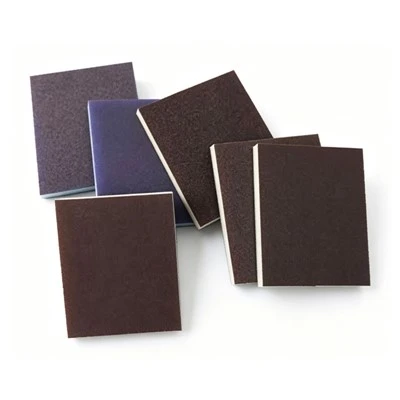



Geometric Access Without Tool Swapping
Sanding tight internal corners and flat panels typically requires switching between different tools. Dual angle sanding sponge features a two-sided design: one flat face and one angled face. The flat side handles broad surface leveling, while the angled edge reaches into grooves, seams, and corners. This eliminates the downtime associated with swapping tools mid-process. The sponge uses aluminum oxide or silicon carbide (P80–P400) and is available in a 100 × 70 × 25mm size.
Construction and Woodworking Uses
Drywall finishers use the angled side to blend internal and external corners and level seam tape, then flip to the flat side for the surrounding wall. Furniture makers use the angled face for cleaning out grooves and edge profiles. Metalworkers apply the angle to deburr section edges. Auto body technicians use it for blending patch edges into the surrounding panel.
Angle Retention
When using the angled side, keeping a steady wrist angle prevents uneven material removal along the corner. The flat side should be held level against the surface. The sponge can be used dry or wet.
Bulk Distribution
Dongguan Sansha Abrasives Co., Ltd. ensures the angled-to-flat transition is cleanly molded and free of separation defects. The product is supplied to hardware distributors and drywall tool suppliers. Standard small batches are dispatched in three days, and large orders are completed in roughly a week. Payment is structured as a 50% deposit, with the balance cleared after inspection.
Product Specifications
|
Parameter |
Specification |
|
Abrasive material |
Aluminum oxide or silicon carbide |
|
Backing type |
Sponge |
|
Grit range |
P80–P400 |
|
Shape |
Dual angle (angled face + flat face) |
|
Use mode |
Dry or wet |
FAQ
Hot Tags: dual angle sanding sponge, China dual angle sanding sponge manufacturers, suppliers, factory, adhesive sandpaper rolls, power sander paper, sanding paper round, small sandpaper, wet and dry abrasive paper, Wet Sanding Disc